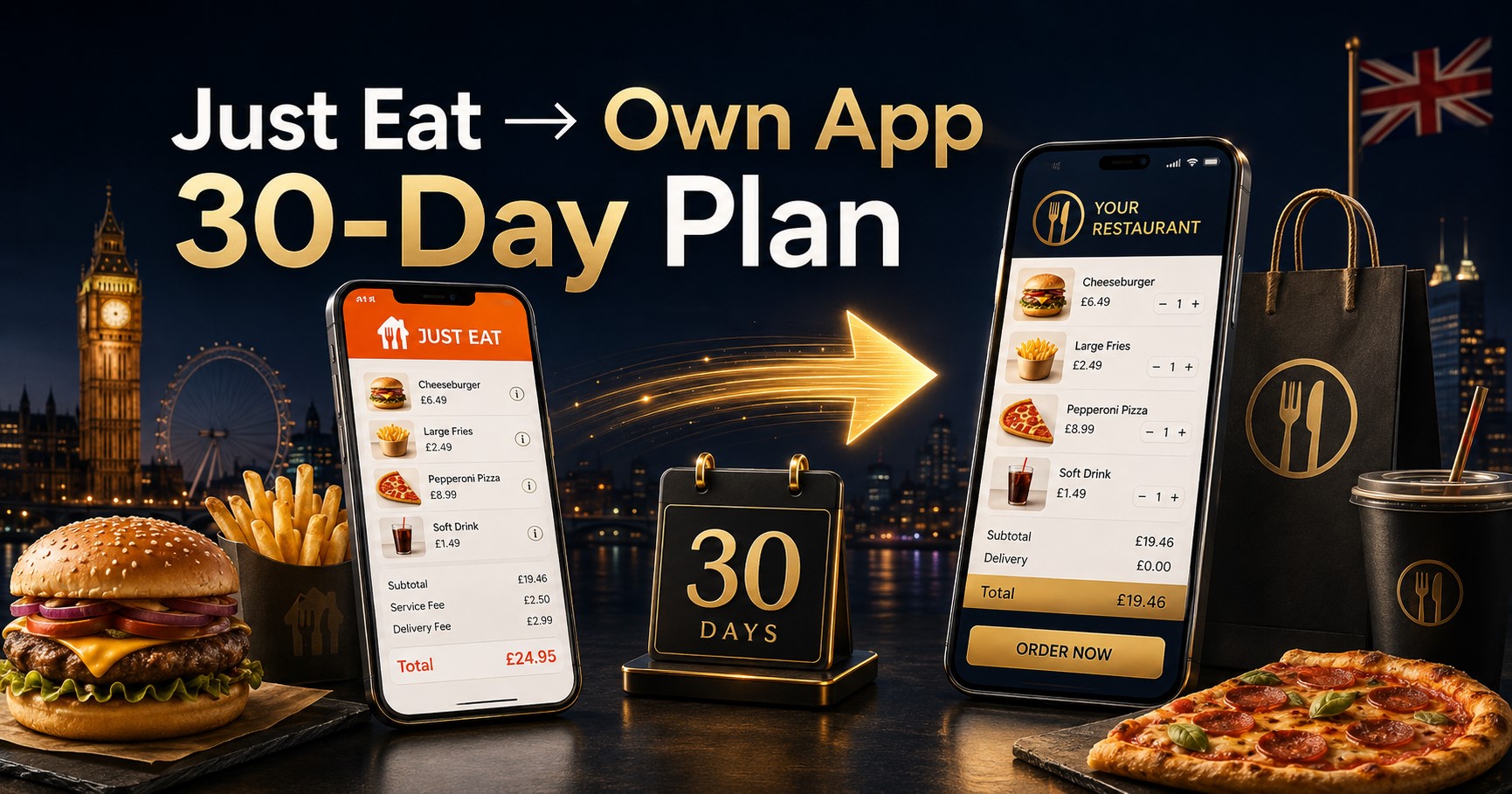
You can switch from Just Eat to your own app in 30 days by running both channels side by side and moving repeat customers across in stages. Set the platform up in week one, load the menu in week two, start converting existing customers in week three, and review the channel split in week four.
The context matters. Lumina Intelligence values the UK foodservice delivery market at £14.8bn for 2026, growing 2.8% year on year - solid, but no longer explosive. Mintel's 2026 analysis notes takeaway prices have more than doubled since 2000 on ONS RPI data, with the steepest climb after 2022. When ticket prices are already stretched, margin has to come from somewhere else. Commission is the largest controllable line item most takeaways have.
This guide is for UK takeaway,’ restaurant and cloud kitchen owners with steady marketplace volume who want a direct channel of their own. You will get a pre-flight checklist, a day-by-day 30-day plan, the conversion tactics that actually work at the counter and in the bag, the data rule most operators miss, and a costed model you can run on your own numbers.
Should you leave Just Eat completely?
For most independents, the answer is no - at least not on day one. The stronger play is to run both channels and shift the balance over time.
Marketplaces do one job extremely well: they put you in front of people who have never heard of you. That discovery has real value, especially in a new area or a new cuisine. What they do not do is hand you a customer relationship you can use again for free.
Your own app does the opposite. It gives you the relationship, the data and the full order value, but it brings no new customers on its own. You supply the demand.
The sensible model treats them as different tools:
- Just Eat - acquisition. New customers, first orders, discovery.
- Your own app - retention. Repeat customers, higher baskets, direct margin.
Once your direct channel is carrying the majority of your repeat volume, you can make a clear-eyed decision about marketplace tiers, spend and placement. That decision is much easier to make from a position of strength.
What changes when you own the channel?
Three things change: what you keep per order, who owns the customer relationship, and how much control you have over the menu and the offer.
Marketplace orderYour own appCommission~14% self-delivery, ~25–30% platform-delivered0%VAT on commissionCharged at 20%, so the effective rate is higherNot applicableCustomer dataHeld by the platformHeld by youRepeat marketingPlatform-controlledYours, with consentMenu controlWithin platform rulesFullDiscounts and promosOften platform-funded termsYou set themRanking / visibilityPlatform algorithmYour marketingNew customer discoveryStrongYou supply it
Commission rates are negotiated per venue and vary by plan, location, volume and exclusivity. Hot takeaway food is standard-rated at 20% VAT under HMRC's catering and takeaway rules, and VAT applies to platform commission too - which is why a headline rate always lands higher in practice. Check your own partner agreement for the figures that apply to you.
Before you start: 5 things to check
Do this in the first three days. It takes an afternoon and prevents every common migration problem.
1. Read your current partner agreement
Look specifically for notice period, minimum term, and any exclusivity or price-parity clauses. Terms vary between venues and are frequently negotiated, so read yours rather than relying on what another operator told you. If anything is unclear, ask your account manager in writing.
2. Decide your delivery model
You need one of three: your own drivers, a third-party courier service you book per order, or collection-only to start. Collection-only is a perfectly good week-one launch. It removes the hardest variable while you get the ordering flow working.
3. Check your payment setup
You will need a merchant account or an integrated payment provider. Typical card processing runs around 1.4% to 1.9% plus a small per-transaction fee. Confirm your payout schedule before launch so cash flow holds steady during the transition.
4. Audit your kitchen workflow
Orders will arrive from two places at once. Decide now whether they land on one tablet, one printer, or into your POS. A single order queue prevents the most common early problem: a direct order sitting unnoticed while marketplace tickets print.
5. Set your baseline numbers
Export 90 days of order data. Record weekly order count, average order value, and your effective commission after VAT. Without these, you cannot prove the migration worked.
The 30-day migration plan
Run all four weeks with Just Eat still live. Nothing gets switched off in this plan.
Week 1 - Build (days 1–7)
- Day 1–2: Choose your platform and confirm your domain. Use a memorable ordering URL or a subdomain of your main site.
- Day 3: Load your top 20 sellers only. A short, clean menu launches faster and tests better than a full catalogue.
- Day 4: Set up modifiers, bundles and your delivery zones with postcode-level pricing.
- Day 5: Connect payments and run three live test orders end to end, including a refund.
- Day 6: Set your opening hours, prep times and cut-offs to match reality, not ambition.
- Day 7: Brief every member of staff. Everyone should be able to explain the direct option in one sentence.
With OrderApps, this week also produces your branded iOS and Android apps - both are included in the same flat subscription, so you are not choosing which half of your customers get a native app.
Week 2 - Load and soft launch (days 8–14)
- Day 8–9: Add the remainder of your menu with proper item descriptions and photography.
- Day 10: Publish and submit the apps to the App Store and Google Play. Allow for review time.
- Day 11: Soft launch to staff, family and your ten most frequent customers. Ask for blunt feedback.
- Day 12: Fix whatever they found. There will be something.
- Day 13: Print in-bag inserts, counter cards and QR stickers.
- Day 14: Set your launch offer. Something modest and repeatable beats a heavy one-off discount.
Week 3 - Convert (days 15–21)
- Day 15: Insert goes into every single delivery bag and collection order. No exceptions.
- Day 16: QR codes go on the counter, the window and the shopfront.
- Day 17: Announce on your social channels and Google Business Profile. Pin the post.
- Day 18: Staff start mentioning the app at the counter and on the phone, using the agreed script.
- Day 19: Update your website so the direct ordering button is the most prominent element above the fold.
- Day 20–21: Watch your first weekend of direct volume. Log every issue.
Week 4 - Review and tune (days 22–30)
- Day 22: Pull direct order count and direct AOV for the first full week.
- Day 23: Compare direct AOV against marketplace AOV. Direct usually runs higher.
- Day 24: Fix the drop-off point. Most sit at delivery-fee display or account creation.
- Day 25: Turn on a loyalty or repeat-order incentive for people who have ordered direct once.
- Day 26–28: Push the insert and QR effort again. Repetition is what builds the habit.
- Day 29–30: Recalculate your channel split and set a 90-day target.
Realistic expectation: most independents see 10% to 20% of total volume come direct in the first month, growing steadily as the habit sets. Treat month one as the foundation, not the finish line.
How to move customers without losing orders
The tactics that work are physical, repeated and attached to an order the customer already placed. Every one of these reaches someone who has just bought from you.
The in-bag insert
The single highest-performing tactic available. A card in every bag, with a QR code, a clear reason to use it, and one sentence of copy. The customer is holding food they enjoy at the moment they read it.
Give the card a specific offer - a free side on the first direct order works better than a percentage discount, because it protects your price point.
The QR code, everywhere
Counter, window, menu, receipt, delivery bag sticker. QR scanning is now completely normal behaviour in UK hospitality. The goal is that a regular cannot miss it.
The staff sentence
One line, said the same way every time. For example: "If you order from our app next time, you'll get a free side and it comes straight to our kitchen."
Consistency matters more than cleverness. Print it and put it by the phone.
The receipt line
Add a single line to every printed receipt with your ordering URL and the offer. It costs nothing and it travels with the customer.
Google Business Profile
Add your direct ordering link to your profile and post about the app. This reaches people at the exact moment they are searching for you by name - which is your warmest possible traffic.
Social, but with a reason
"We have an app" converts poorly. "Order direct this week and the garlic bread is on us" converts. Give people a reason tied to a date.
The data rule most takeaways miss
You cannot lawfully email marketplace customers whose details you did not collect yourself. This catches out a lot of operators who assume a customer list is a customer list.
UK direct marketing sits under the Privacy and Electronic Communications Regulations (PECR), enforced by the Information Commissioner's Office. Marketing emails and texts to individuals generally need consent, with one narrow exception known as the soft opt-in.
The ICO is explicit that the soft opt-in only applies where you obtained the contact details directly from the person yourself. It does not apply where another organisation obtained the details for you, and there is no such thing as a third-party marketing list that qualifies.
What this means in practice:
- Marketplace order data is not a mailing list you can use.
- Every direct order you take builds a list you can use, provided you offer an opt-out at the point of collection and in every message.
- This is a compounding advantage. Month one gives you a small list. Month twelve gives you a real one.
- Physical tactics - inserts, QR codes, counter conversations - are how you bridge the gap in the meantime.
Treat your consent wording as a launch-day task, not an afterthought. Get it right once and it works for years.
What a 30% migration is worth
Here is the model. Swap in your own figures.
Starting position
- 200 marketplace orders per week
- £22.00 average order value
- £4,400 weekly marketplace revenue
After migrating 30% of those orders direct
- 60 orders per week now placed on your own app
- £1,320 weekly revenue moved to the direct channel
What that £1,320 costs you on each channel
ChannelRate appliedWeekly cost on £1,320Annual costMarketplace, you deliver~14% + VAT = ~16.8%£222£11,540Marketplace, platform delivers~30% + VAT = ~36%£475£24,700Your own app0% commission + ~1.5% card fees£20£1,040
Annual saving on the migrated volume
- Coming from the self-delivery tier: ~£10,500 a year
- Coming from the platform-delivered tier: ~£23,660 a year
And that is before the basket effect. Direct baskets commonly run higher than marketplace baskets, because customers are not watching a service fee climb as they add a side. If your direct AOV lands even £1.50 above marketplace AOV, that is another £4,680 a year on 60 weekly orders.
Commission percentages above are commonly reported 2026 UK ranges. Use your own contracted rate for a precise figure.
Summary
Switching from Just Eat to your own app works best as a 30-day migration with both channels running. Build in week one, load and soft launch in week two, convert customers in week three, and review your channel split in week four.
The technology takes days. The habit change takes months, and it is driven by physical, repeated prompts: in-bag inserts, QR codes, receipt lines and a consistent staff sentence. Set your consent wording up on day one, because you cannot borrow a marketplace's customer list - the ICO is clear that the soft opt-in needs details you collected yourself.
On 200 weekly orders at £22, moving 30% direct is worth roughly £10,500 to £23,660 a year before any basket uplift. Keep the marketplace for discovery. Keep the margin for yourself.
Ready to grow your food business?
Commission-free ordering, branded apps, bookings, and EPOS on one platform.