Average order value is the average amount a customer spends per order. Most UK takeaways see it stall because the menu asks for one decision, the basket offers no second one, and the delivery threshold sits at or below what people already spend.
That matters more in 2026 than it did five years ago. Lumina Intelligence puts the UK foodservice delivery market at £14.8bn for 2026, growing 2.8% year on year - steady, but no longer the runaway growth of the pandemic years. Mintel's 2026 analysis adds that takeaway prices have more than doubled since 2000 based on ONS RPI data, with the sharpest rise coming after 2022. Growth is coming from ticket size, not from a flood of new customers.
This guide is for independent takeaway, restaurant and cloud kitchen owners in the UK who already have steady order volume and want more revenue from it. You will get a working formula, nine specific fixes, a costed uplift model you can run on your own numbers, and a 30-day test plan.
What is average order value?
Average order value is the average amount a customer spends in a single order. It is the simplest lever a takeaway has, because it grows revenue without needing more customers, more drivers or more marketing spend.
AOV is different from order frequency. Frequency asks how often someone orders. AOV asks how much they spend when they do. You need both, but AOV moves faster because you control it entirely through your menu and checkout.
Two takeaways can run identical order counts and end the month thousands apart. The difference is usually sides, drinks, desserts and dips.
How do you calculate average order value?
Divide total revenue by total number of orders over the same period. Use gross order value before commission and before delivery fees, so the number reflects customer behaviour rather than platform deductions.
AOV = Total order revenue ÷ Number of orders
Worked example
A takeaway does £5,375 in a week across 250 orders.
£5,375 ÷ 250 = £21.50 AOV
That single number is not enough on its own. Split it four ways before you change anything:
- By channel - your own site versus each marketplace
- By fulfilment - delivery versus collection
- By daypart - lunch versus evening
- By day - weekday versus weekend
Delivery baskets almost always run higher than collection baskets, because delivery orders tend to feed more than one person. Direct-site baskets often run higher still, because customers are not watching a service fee climb as they add items. Averaging all of it together hides the segment where the opportunity actually sits.
Why is your average order value stuck?
AOV plateaus when the ordering journey only ever asks one question: what is your main? Five specific patterns cause it.
1. The menu is a list, not a build
A flat list of dishes invites one selection. A structured journey - main, then size, then side, then drink - invites four. Most takeaway menus are still built as printed catalogues that happen to live online.
2. Sides and drinks sit at the bottom
Customers scroll to their category, choose, and head for checkout. Anything below the fold rarely gets seen. Your highest-margin items are often the ones nobody scrolls to.
3. The delivery threshold sits below current AOV
If your free-delivery threshold is £15 and your AOV is £21.50, the threshold does nothing. It is already cleared before the customer thinks about it. A threshold only shapes behaviour when it sits just above where people naturally land.
4. Marketplace fee stacking shrinks baskets
On a marketplace, customers watch a service fee and delivery fee build alongside the food total. Adding a £2.50 side feels heavier when £4 of fees is already on screen. The same customer on your own site sees a cleaner total and adds more freely.
5. Nobody is watching AOV by channel
If you only see one blended number in a monthly report, you cannot tell which channel is growing and which is flat. Most operators discover their direct-site AOV is materially higher than their marketplace AOV the first time they split the data.
9 ways to increase average order value
1. Add modifiers to your ten best sellers
Take your ten highest-volume dishes and give each one real options: portion size, spice level, protein swap, extra topping, side upgrade. Price each modifier between 80p and £2.50.
A modifier is the lowest-friction upsell that exists, because the customer is already committed to the dish. On a platform like OrderApps, modifier groups sit inside the item itself, so the question arrives at the exact moment the customer is deciding.
2. Build three bundles on a clear price ladder
Three tiers work better than five. Five creates hesitation. Price the middle tier as the obvious choice and anchor it with a visible saving.
BundleContentsBundle priceÀ la carteSavingSolo1 main, 1 side, 1 drink£13.95£15.85£1.90Duo (feature this)2 mains, 2 sides, 1 starter, 2 drinks£26.95£31.40£4.45Family4 mains, 3 sides, 2 starters, bottle£46.95£55.20£8.25
Feature the Duo tier with a badge. Most independents find the middle tier carries the majority of bundle orders once it is visually prioritised.
3. Set your delivery threshold above your current AOV
Take your delivery AOV and set the free-delivery or minimum-order threshold 15% to 25% above it.
At £21.50 AOV, a £25 threshold gives customers a £3.50 gap to close. That gap is closed with a side, a dessert or two drinks - items that carry strong margin. Set it too high and orders drop. Set it too low and it earns nothing.
Review the threshold quarterly, because it needs to move as your AOV moves.
4. Move drinks and sides to the checkout step
The basket page is the highest-intent screen in the whole journey. The customer has decided to buy. A short prompt at that moment - four items, one tap each - converts far better than a category buried at the bottom of the menu.
Keep it to four suggestions. Longer lists read as clutter and get skipped.
5. Rewrite your top ten item descriptions
Swap generic lines for specific ones. "Chicken burger" becomes "Buttermilk-brined chicken thigh, brioche bun, house pickles, smoked garlic mayo."
Specifics do two jobs. They raise perceived value, which supports a higher price point. They also give search engines and AI answer engines something concrete to work with when someone searches for your dish by description.
6. Add a "make it a meal" prompt on the item page
When a customer adds a main, offer the meal version in the same interaction. One tap, one clear price difference, no navigation.
Show the upgrade as a difference, not a total. "+£3.50 for chips and a drink" reads better than "£17.45 meal."
7. Present prices without the pound sign
This one comes from published research. A Cornell University study by Yang, Kimes and Sessarego, run at the Culinary Institute of America and reported in the International Journal of Hospitality Management, tested three price formats across 201 dining parties. Guests given menus with numerals only - no currency symbol, no written "dollars" - spent about 8% more per person than those given menus with the symbol.
The researchers suggested that repeated currency references prime the "pain of paying." Their own framing was that it is low-hanging fruit: easy to implement, small yield, very little downside.
Write 12.50 rather than £12.50 on your menu listing. Keep the symbol at checkout, where clarity matters more than psychology. Avoid .99 endings in food; they read as discount signalling and pull perceived quality down.
8. Reward the second item, not the first order
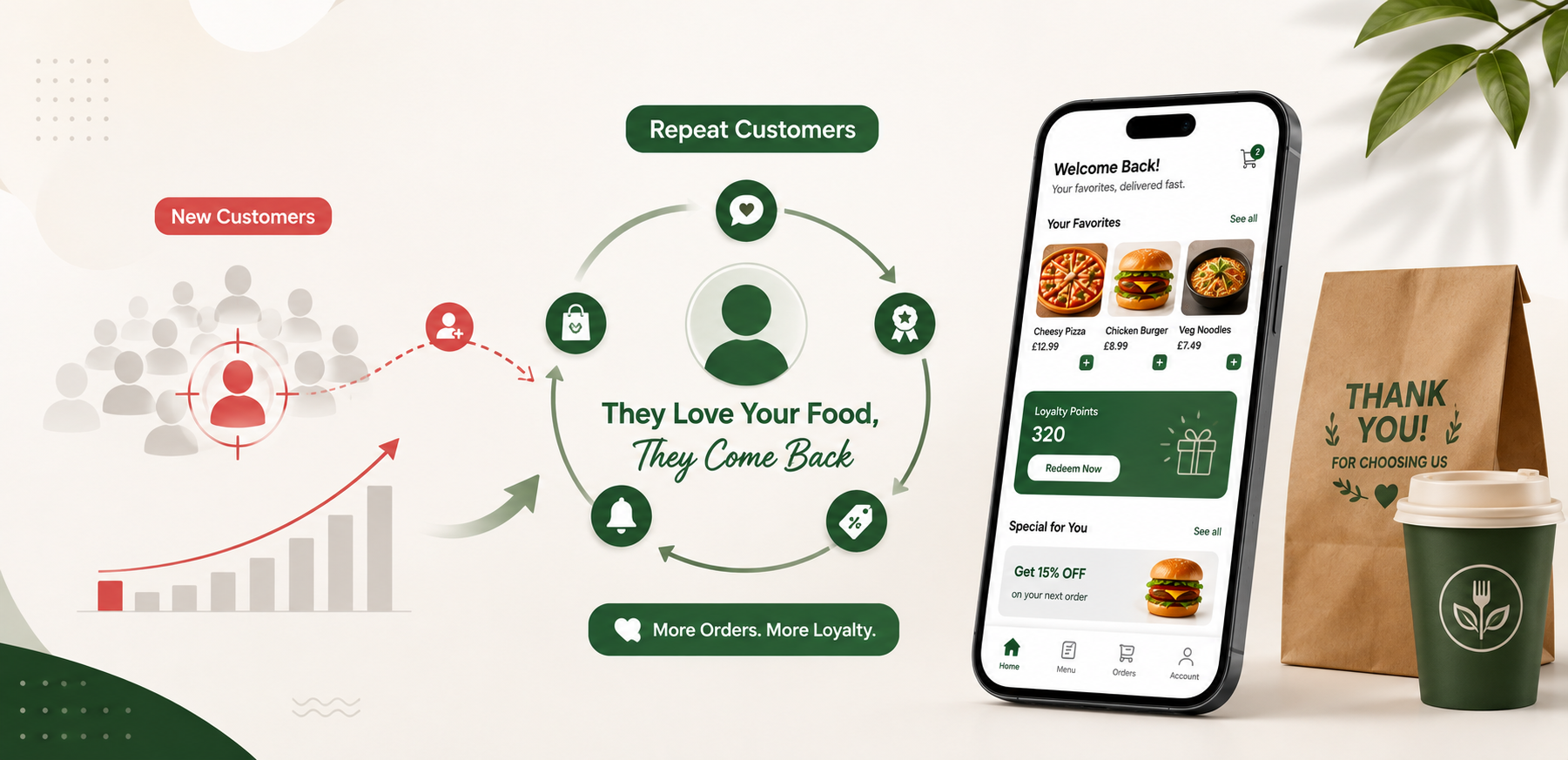
Most loyalty schemes discount the order. That is a reward for buying, which the customer was already doing. Reward the basket instead.
Structures that work:
- Free side above a set basket value
- Free dessert on the third order in a month
- Points weighted toward sides and drinks rather than mains
The goal is to make the extra item feel earned rather than sold.
9. Own the channel so the uplift stays with you
Every fix above works on any platform. What changes is how much of the gain reaches your bank account.
Marketplace commission in the UK is typically reported at around 14% when you handle delivery yourself, rising to roughly 25% to 30% when the platform's couriers deliver. VAT is charged on that commission, so the effective deduction runs higher than the headline rate. Hot takeaway food is standard-rated at 20% VAT under HMRC's rules for catering and takeaway.
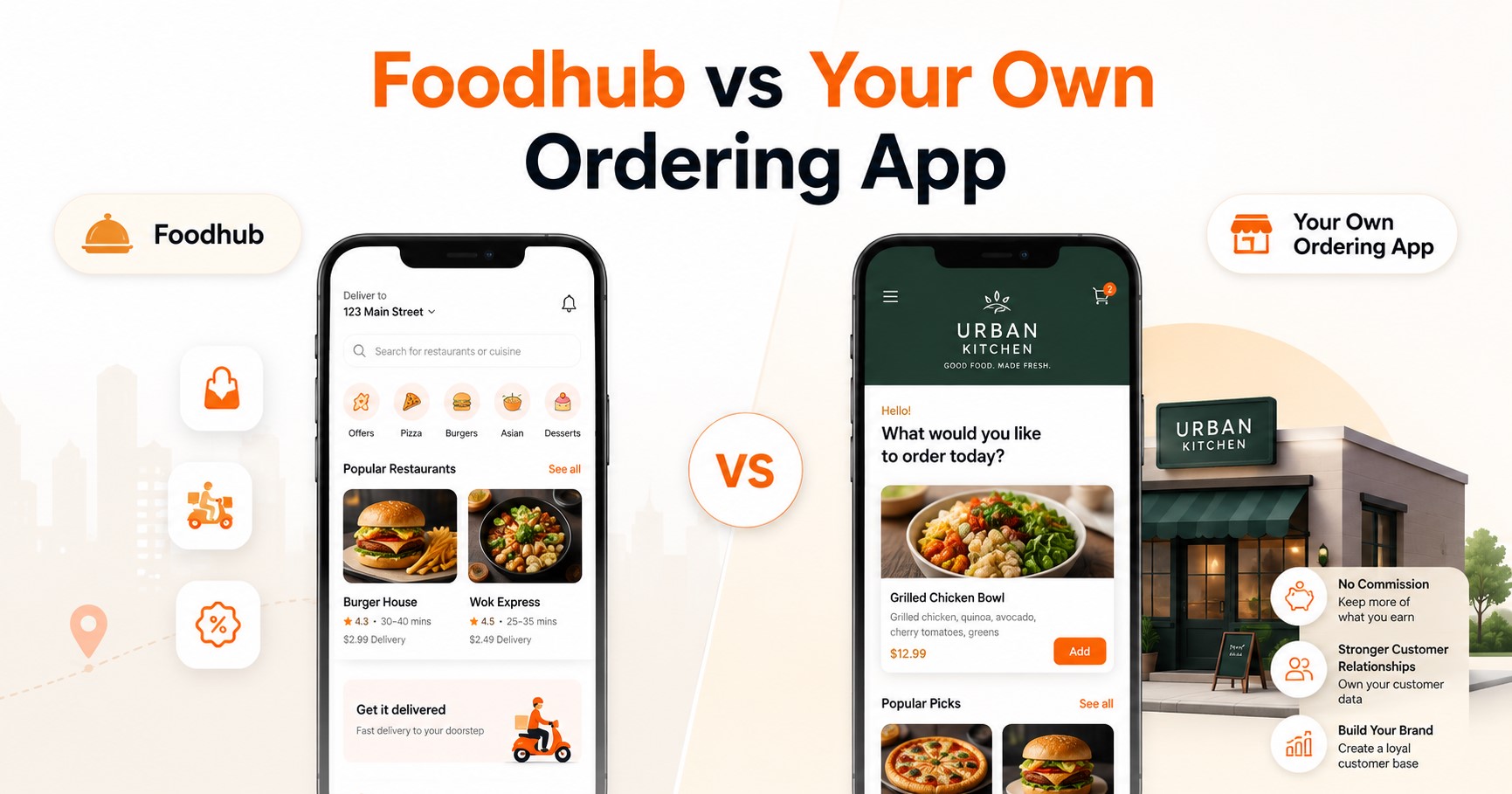
A direct ordering channel changes that arithmetic. OrderApps runs on a flat monthly subscription with 0% commission, and includes both the iOS and Android apps in the same fee - so you are not choosing which half of your customer base gets a native app.
The practical approach most operators land on: keep the marketplaces for discovery, and give repeat customers a reason to order direct.
The £2 uplift model
Here is the calculation, run on the example takeaway above. Swap in your own numbers.
Starting position
- 250 orders per week
- £21.50 average order value
- £5,375 weekly revenue
- £279,500 annual revenue
After a 10% AOV lift (+£2.15)
- 250 orders per week (unchanged)
- £23.65 average order value
- £5,912.50 weekly revenue
- +£537.50 per week
- +£27,950 per year
What that £2.15 actually is
One side at £3.49 added to 62% of orders. Or two drinks at £1.75 on 61% of orders. Or a dessert at £4.50 on 48% of orders. These are achievable attach rates when the prompt appears at the right moment.
The alternative route
To gain the same £27,950 through volume alone at £21.50 AOV, you would need 25 extra orders every week - 1,300 additional orders a year. That means acquisition spend, more driver capacity and more kitchen throughput at peak.
The AOV route needs none of those things. It needs a menu edit and a checkout prompt.
Where your AOV uplift actually lands
The same £537.50 weekly uplift arrives very differently depending on where the order was placed. Figures below use commonly reported 2026 UK commission ranges and apply 20% VAT to commission.
ChannelTypical commissionEffective deduction with VATYou keep from £537.50Annual difference vs directMarketplace, platform delivers~30%~36%~£344~£9,500Marketplace, you deliver~14%~16.8%~£447~£4,000Your own site (flat fee)0% + card fees (~1.5%)~1.5%~£529-
Commission rates are negotiated per venue and change often. Check your own agreements for the figures that apply to you.
The pattern holds regardless of the exact percentages. Work done to grow the basket is worth more on a channel that does not take a share of it.
A 30-day plan to test AOV changes
Change one thing at a time. Otherwise you learn nothing about what worked.
- Days 1–3 - Baseline. Export 90 days of order data. Calculate AOV split by channel, fulfilment type, daypart and day of week. Write the numbers down.
- Days 4–7 - Modifiers. Add option groups to your ten top sellers. Nothing else changes this week.
- Days 8–14 - Basket prompt. Add four suggested add-ons at the checkout step. Record attach rate daily.
- Days 15–21 - Threshold. Raise the delivery threshold to 15–20% above delivery AOV. Watch order count as closely as basket size.
- Days 22–28 - Bundles. Publish the three-tier ladder. Badge the middle tier.
- Days 29–30 - Review. Recalculate AOV by channel. Keep what moved. Roll back what did not.
Track order count alongside AOV throughout. A threshold that lifts AOV while cutting order volume is a net loss, and you will only see it if you watch both.
Summary
Average order value is total revenue divided by order count, and it is the fastest revenue lever a UK takeaway has. It stalls when the menu asks one question, the basket asks none, and the delivery threshold sits below where customers already spend.
Nine fixes move it: modifiers on top sellers, a three-tier bundle ladder, a threshold set above current AOV, checkout-stage add-ons, specific item descriptions, a meal-upgrade prompt, cleaner price presentation, loyalty that rewards the basket, and a direct channel that keeps the uplift.
On 250 orders a week at £21.50, a 10% lift is worth around £27,950 a year with no new customers. How much of that reaches you depends on where the order was placed.
FAQs
What is a good average order value for a UK takeaway?
There is no universal benchmark, because cuisine and basket composition vary widely. A pizza takeaway and a sushi restaurant will never share a target. The number that matters is your own AOV over the last 90 days. Set a target 10% above it and measure monthly.
How do you calculate average order value?
Divide total order revenue by the total number of orders over the same period. Use gross order value before commission. For a takeaway doing £5,375 across 250 orders in a week, AOV is £21.50.
Does a free delivery threshold increase average order value?
Yes, when it sits above where customers naturally land. A threshold set below current AOV changes nothing, because customers clear it without noticing. Set it 15% to 25% above your delivery AOV and watch order count alongside basket size.
Why is my average order value falling?
The most common causes are promotional discounting that trains customers to buy less at full price, a shift in channel mix toward lower-basket platforms, or add-ons becoming harder to find after a menu redesign. Split your AOV by channel first - the drop is usually concentrated in one place.
Is average order value higher on direct ordering or marketplaces?
Direct baskets commonly run higher. Customers on a restaurant's own site are not watching service and delivery fees accumulate as they add items, so the friction on that extra side is lower. Split your own data by channel to confirm the gap in your business.
Ready to grow your food business?
Commission-free ordering, branded apps, bookings, and EPOS on one platform.