StartFragment
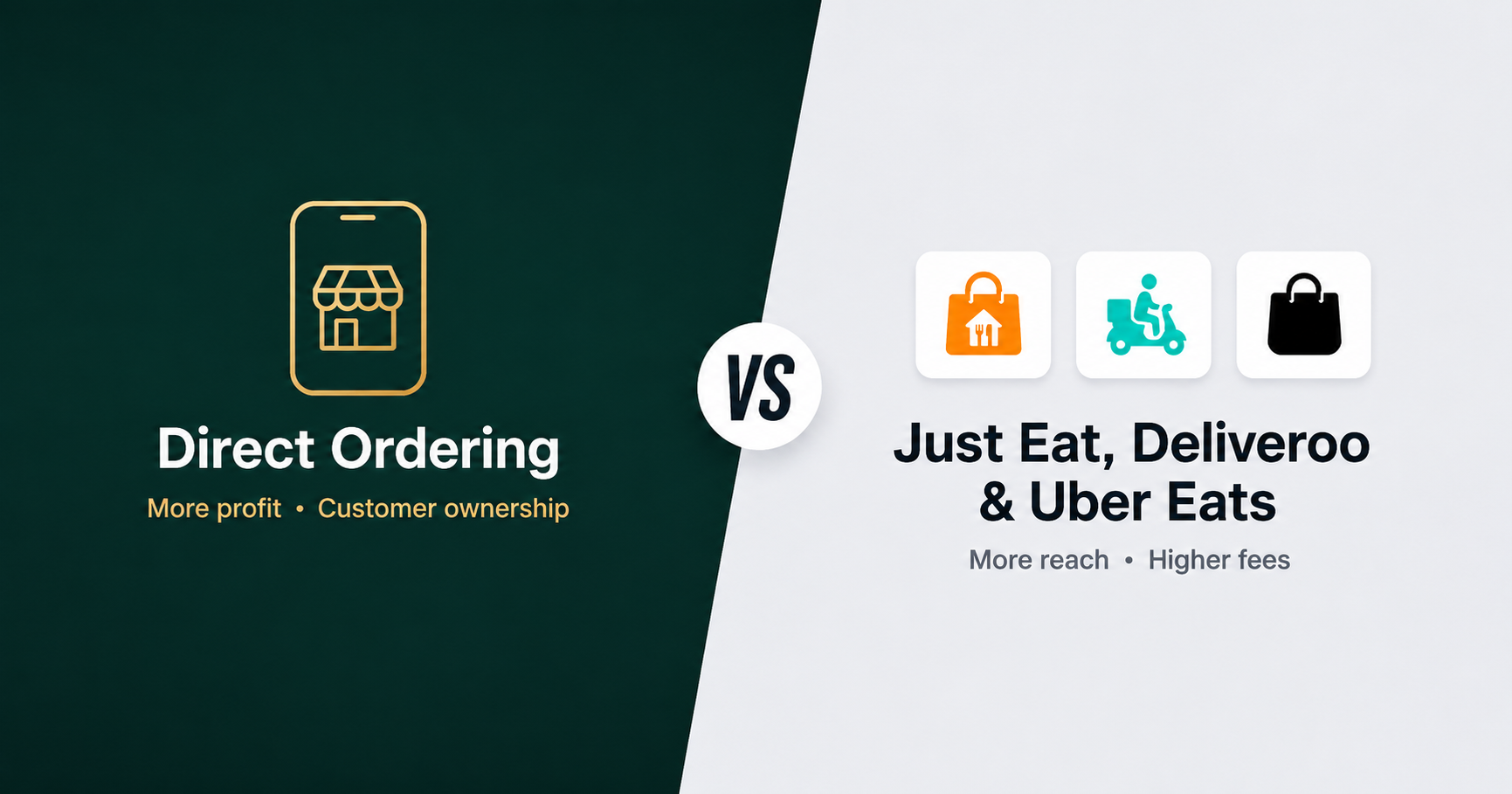
Online food delivery platforms have changed how customers discover and order from restaurants.
Just Eat, Deliveroo and Uber Eats can place your menu in front of thousands of hungry customers. They provide convenient ordering, payment and delivery options through apps that many people already use.
However, marketplace orders also come with fees, competition and limited control over the customer relationship.
StartFragment
Direct online orderingoffers a different approach. Customers place orders through your own branded restaurant website or mobile app rather than through a third-party marketplace.
EndFragment
So, which option is better for your restaurant?
For many UK restaurants, the best answer is not choosing one and completely abandoning the other. A stronger strategy is to use delivery marketplaces for customer discovery while building a direct ordering channel for repeat business.
This guide explains the differences, advantages, costs and practical considerations.
What Is Direct Online Ordering?
Direct online ordering means customers order food through a digital channel controlled by your restaurant.
This could be:
- Your restaurant website
- Your branded mobile app
- A QR code at the table
- A collection-ordering page
- A link from your Google Business Profile
- A link from Instagram, Facebook or email campaigns
The ordering experience uses your restaurant’s name, logo, colours, menu and promotions.
OrderApps, for example, gives UK food businesses a branded ordering website, mobile apps and tools for delivery, collection, table reservations, loyalty and customer marketing. Restaurants can manage menus, prices, promotions and orders through the platform.
The customer is ordering from your business rather than finding you inside a list of competing restaurants.
How Do Food Delivery Marketplaces Work?
Food delivery marketplaces bring many restaurants together inside one app or website.
Customers can search by location, cuisine, price, rating or delivery time. They select a restaurant, place their order and pay through the platform.
The marketplace may then:
- Send the order to the restaurant
- Process the customer’s payment
- Provide delivery drivers
- Manage customer support
- Offer advertising and promotional tools
- Recommend the restaurant to app users
Just Eat allows restaurants to use their own couriers or select a service where Just Eat manages delivery. Its partner information states that restaurants using their own couriers pay a reduced commission on delivery orders.
Deliveroo describes its service fee as a percentage of the order’s gross merchandise value, with the exact commercial terms determined by the restaurant’s agreement.
Uber Eats also uses percentage-based marketplace fees. Its UK merchant pricing page lists different arrangements depending on whether the restaurant uses Uber delivery, self-delivery or pickup.
These platforms can provide valuable reach, but the restaurant normally pays for access to that reach through commissions, service fees, promotional spending or a combination of charges.
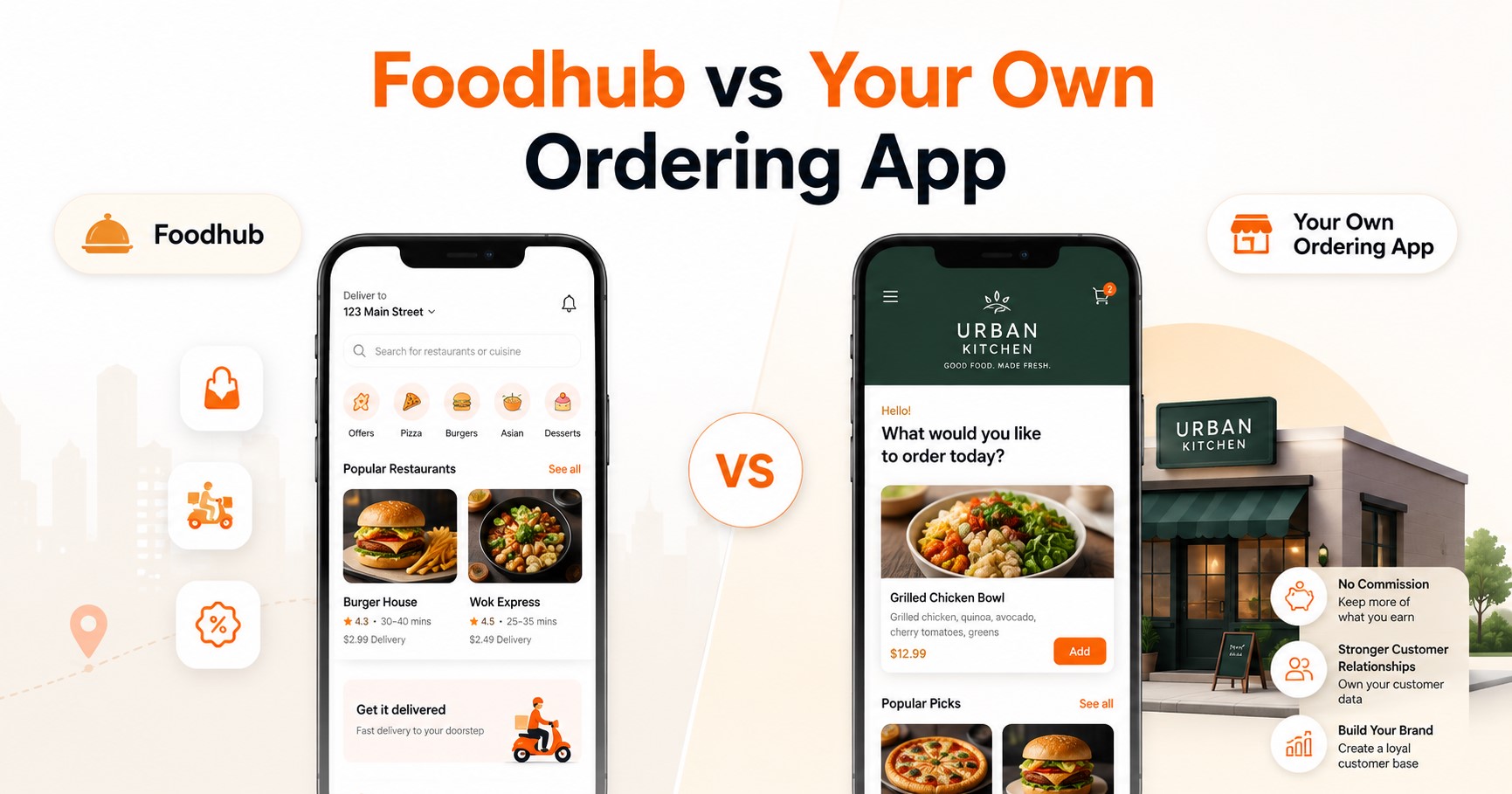
Direct Ordering vs Delivery Apps at a Glance
Direct online ordering
With direct ordering, your restaurant controls the customer experience.
You decide:
- How your website looks
- Which products appear
- How items are described
- What prices customers see
- Which delivery areas you serve
- What promotions you offer
- How you reward regular customers
- How you communicate with customers
The customer sees your restaurant’s brand throughout the ordering process.
Delivery marketplaces
Marketplaces provide access to customers who are already searching for food.
They may be particularly useful when:
- Your restaurant is new
- You have limited local awareness
- You do not have delivery drivers
- You want to reach customers outside your existing audience
- You want additional orders during quieter periods
The trade-off is that your restaurant appears beside many competitors, and the platform controls much of the customer journey.
1. Customer Reach and Discovery
Delivery apps are powerful discovery platforms.
Someone may open Just Eat, Deliveroo or Uber Eats without knowing which restaurant they want. They browse available options and choose based on cuisine, price, reviews, photographs, promotions or delivery time.
This gives restaurants access to customers who might never have visited their website.
Deliveroo promotes its marketplace as a way for restaurants to reach new and exclusive customers, while Uber Eats presents its service as a way to increase reach and connect with local customers.
Direct ordering works differently.
Customers normally need to know your restaurant, discover it through Google, follow a social media link or receive a recommendation before reaching your ordering page.
This means marketplaces often have an advantage in first-time discovery.
However, once a customer already knows and trusts your restaurant, paying a marketplace fee every time that person returns may be less attractive than encouraging them to order directly.
Marketplace advantage: New customer discovery.
Direct ordering advantage: Repeat orders from customers who already know your business.
2. Fees and Order Profitability
Fees are one of the biggest differences between direct ordering and marketplace ordering.
Marketplace fees usually depend on:
- Whether the platform supplies a courier
- Whether you use your own drivers
- Your restaurant agreement
- Order type
- Promotional arrangements
- Additional advertising
- VAT and other applicable charges
Restaurants should request a complete written fee breakdown from each provider rather than relying on a general percentage found online.
Direct ordering also has costs. It should not automatically be described as completely free.
As of July 2026, OrderApps publishes three plans:
- Starter: £19 per month with a 3.9% transaction charge
- Growth: £29.99 per month with a 1.9% transaction charge
- Premium: £39.99 per month with a 1.49% transaction charge
A one-time £99 setup fee is also listed. The plans include different combinations of branded online ordering, mobile apps, reservations, QR ordering and automated marketing.
Payment-processing, delivery, VAT and other operating costs should also be confirmed before making a final comparison.
The important question is not whether one option is technically free. The better question is:
How much profit remains after every cost connected to the order?
How to Compare Your Real Cost per Order
Use this simple calculation:
Order value − food cost − packaging − delivery cost − platform charges − payment charges − discounts = estimated contribution from the order
Run this calculation separately for:
- A marketplace delivery order
- A marketplace collection order
- A direct delivery order
- A direct collection order
This gives you a more realistic comparison than looking at commission alone.
For example, direct collection may produce a strong margin because you do not need a marketplace courier. Direct delivery may still involve driver wages or a third-party delivery charge.
The best option depends on your order value, location, menu margins and delivery model.
3. Control Over Your Brand
On a delivery marketplace, customers are primarily using the marketplace’s app.
Your logo, menu and food photographs appear inside a platform designed and controlled by another company. Customers can quickly compare your restaurant with nearby alternatives.
Direct ordering creates a more focused experience.
Your website can use:
- Your restaurant logo
- Your colours
- Your photography
- Your tone of voice
- Your story
- Your own promotional banners
- Your loyalty programme
OrderApps provides an own-branded ordering website and, on applicable plans, branded iOS and Android apps. Restaurants can manage menus, pricing, design and promotions through their own system.
This helps customers remember the restaurant they ordered from rather than only remembering the delivery app.
Brand recognition matters because customers who remember your name are more likely to search for you directly in the future.
4. Ownership of the Customer Relationship
A direct order creates an opportunity to build a long-term relationship with the customer.
With appropriate consent and privacy controls, you may be able to use customer information to:
- Send relevant offers
- Announce new menu items
- Promote quieter days
- Reward regular customers
- Remind inactive customers
- Encourage app downloads
- Request feedback
OrderApps states that its direct system allows restaurants to retain customer data and use built-in loyalty, push-notification and marketing tools to encourage repeat orders.
On a marketplace, the platform usually manages the main customer account and controls how customer information can be accessed or used.
You can fulfil the order, but you may have fewer opportunities to turn that customer into part of your own marketing audience.
Any direct marketing must still follow UK data-protection and electronic-marketing requirements. Customers should understand what they are agreeing to receive, and unsubscribing should be simple.
5. Competition During Checkout
A customer visiting your own ordering website has already selected your restaurant.
They are not being shown dozens of nearby competitors while browsing your menu.
On a marketplace, your listing may appear beside restaurants offering:
- Lower prices
- Faster delivery
- Free delivery
- Large discounts
- Sponsored placement
- Different cuisines
- Higher review scores
This creates constant comparison.
A customer may begin by looking at your restaurant and then move to another option before placing the order.
Direct ordering removes most of this distraction. The entire experience is focused on your menu and your offers.
However, your website still needs to be easy to use. A slow, confusing or poorly designed ordering page can push customers back to a familiar marketplace app.
6. Menu and Pricing Control
A direct ordering platform gives you greater control over how your menu is presented.
You can decide:
- Which products appear first
- How categories are organised
- Which add-ons are available
- When an item becomes unavailable
- Which delivery zones are active
- What minimum order applies
- Whether customers can schedule an order
- Which discount codes are accepted
OrderApps includes menu customisation, delivery-zone controls, order scheduling, promotional codes and the ability to update products and pricing.
Marketplaces also provide menu-management tools. For example, Just Eat allows partners to edit menu items, variations and pricing through its Partner Hub.
The key difference is where the menu appears and who controls the overall customer experience.
7. Delivery Management
Marketplace delivery can be useful for restaurants without their own courier team.
The platform may handle:
- Driver recruitment
- Driver availability
- Delivery tracking
- Courier payments
- Customer delivery updates
- Delivery support
This can reduce the operational work required to launch delivery.
Direct ordering does not always include delivery drivers. Your restaurant may need to:
- Employ drivers
- Use independent couriers
- Connect to a third-party delivery service
- Set delivery zones
- Calculate delivery charges
- Manage driver availability
For some restaurants, this is manageable and cost-effective. For others, marketplace delivery may be more convenient.
A restaurant should separate two decisions:
- Where will the customer place the order?
- Who will deliver the food?
Customers can order directly while delivery is completed by your own driver or a separate delivery provider.
8. Loyalty and Repeat Orders
Marketplaces may offer their own promotions and loyalty features, but these usually keep the customer active within the marketplace ecosystem.
Direct ordering lets you create loyalty around your restaurant.
You could offer:
- Points for every direct order
- A free item after several purchases
- Birthday rewards
- First direct-order discounts
- Collection-only promotions
- App-exclusive offers
- Rewards for referrals
OrderApps includes loyalty features, promotional tools and, on its Premium plan, automated email and push-notification marketing.
The objective is not simply to discount every order.
A good loyalty programme gives customers a clear reason to choose your restaurant directly while protecting your margins.
9. Marketing Opportunities
Marketplaces can expose your restaurant to a large audience, but extra visibility may involve paid promotions or sponsored placement.
Direct ordering allows you to generate orders through channels you control, including:
- Google Business Profile
- Local SEO
- Social media
- Text messages
- Push notifications
- Printed flyers
- Packaging inserts
- In-store QR codes
A simple message on every order bag can make a difference:
“Next time, order directly from our website for exclusive rewards.”
You can also train staff to mention the direct ordering option to collection and dine-in customers.
Over time, these small actions can shift repeat customers towards your own platform.
When Should a Restaurant Use Just Eat, Deliveroo or Uber Eats?
A marketplace may be valuable when your restaurant:
- Needs immediate online visibility
- Is entering a new delivery area
- Does not have its own drivers
- Wants to test demand for delivery
- Has spare kitchen capacity
- Wants to attract first-time customers
- Can maintain acceptable margins after fees
A marketplace order can still be profitable if it creates additional business that you would not otherwise receive.
The problem begins when loyal customers repeatedly order through a high-cost acquisition channel even though they would willingly order directly.
When Should a Restaurant Prioritise Direct Ordering?
Direct ordering should become a priority when your restaurant:
- Already has repeat customers
- Receives branded Google searches
- Has an active social media audience
- Wants greater control over customer data
- Wants to build its own loyalty programme
- Needs more control over pricing and promotions
- Can manage delivery or collection effectively
- Wants to strengthen its own brand
Direct ordering is especially suitable for collection orders because the restaurant may not need to pay for third-party delivery.
It can also work well for regular takeaway customers who already know what they want.
The Best Strategy: Use Both Channels Differently
Restaurants do not need to treat direct ordering and marketplaces as enemies.
Each channel can serve a different purpose.
Use marketplaces for acquisition
Use Just Eat, Deliveroo and Uber Eats to:
- Reach new customers
- Increase local visibility
- Fill unused kitchen capacity
- Enter new delivery areas
- Offer delivery without building a courier team
Use direct ordering for retention
Use your own website and app to:
- Serve existing customers
- Promote collection
- Build loyalty
- Gather customer insights
- Run your own offers
- Increase brand recognition
- Encourage repeat orders
This creates a simple customer journey:
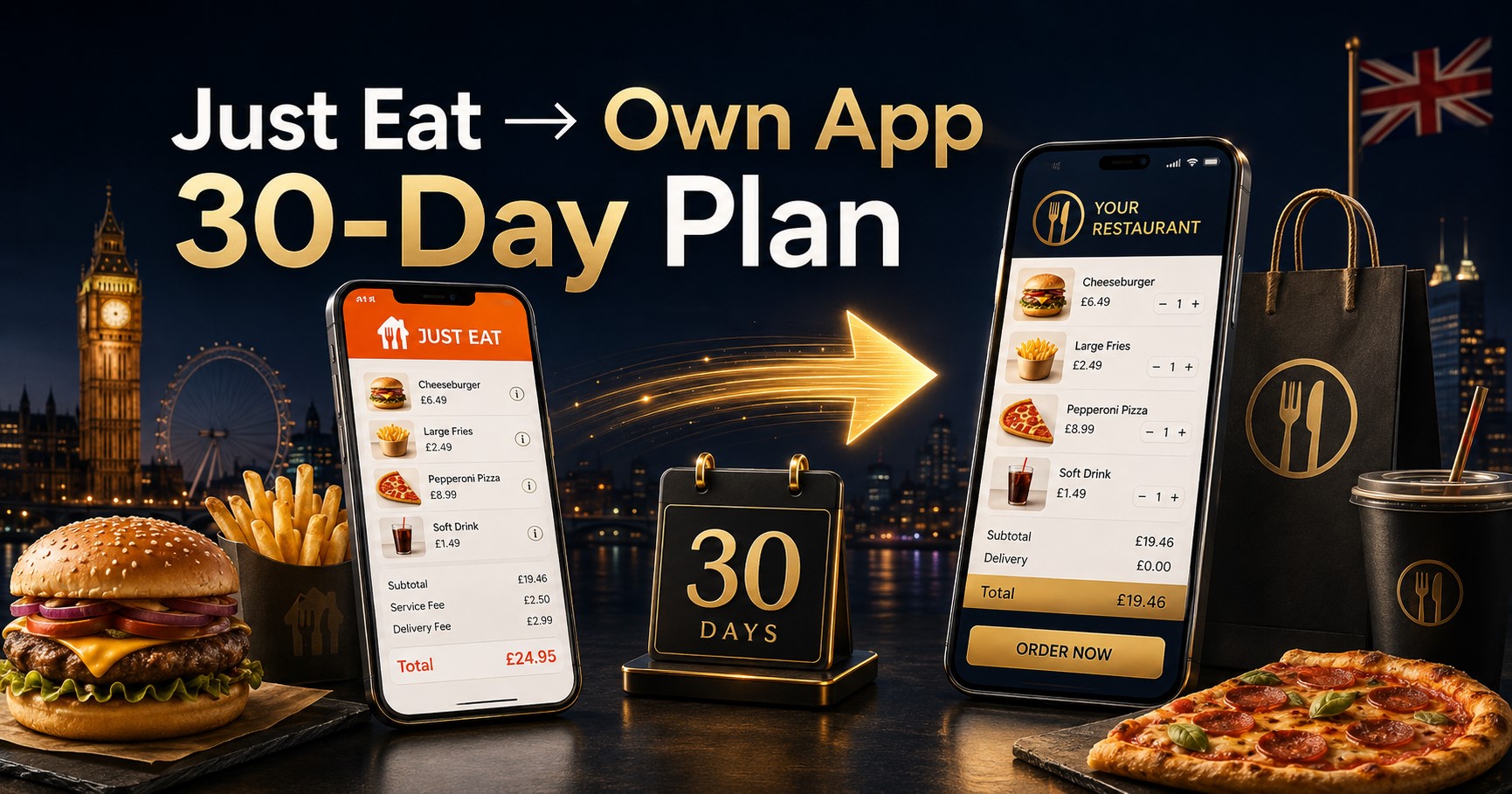
Marketplace discovery → good first experience → direct repeat order → loyalty
The goal is not to remove your marketplace listings overnight. It is to stop depending on them for every returning customer.
How to Move More Customers to Direct Ordering
Step 1: Create a professional ordering website
Your direct ordering page must work well on mobile devices.
Customers should be able to:
- Find products quickly
- Select options easily
- See delivery charges clearly
- Choose collection or delivery
- Pay without confusion
- Receive confirmation immediately
Step 2: Give customers a reason to order directly
People rarely change habits without a benefit.
Offer something valuable but sustainable, such as:
- Loyalty points
- A small direct-order discount
- A free side after several purchases
- Lower collection prices
- App-only rewards
- Exclusive menu items
Step 3: Promote the direct link everywhere
Place your ordering link on:
- Google Business Profile
- TikTok
- Your email signature
- Printed menus
- Receipts
- Shop windows
- Food packaging
- Delivery bags
Step 4: Train your team
Staff should know how the system works and how to explain it.
A simple sentence is enough:
“You can order directly from our website next time and collect loyalty rewards.”
Step 5: Make direct ordering reliable
Customers will return to marketplace apps if your direct system causes problems.
Regularly check:
- Menu accuracy
- Opening times
- Sold-out products
- Delivery zones
- Order notifications
- Payment processing
- Estimated preparation times
Step 6: Measure the results
Track:
- Direct orders per month
- Marketplace orders per month
- Average order value
- Repeat-order rate
- Collection versus delivery
- Discounts used
- Cost per order
- Customer acquisition source
This helps you decide where to invest your marketing budget.
How OrderApps Supports Direct Ordering
OrderApps is designed to give UK restaurants, takeaways and cafés their own digital ordering channel.
Depending on the selected plan, available features include:
- A branded online ordering website
- Delivery and collection ordering
- Built-in point of sale
- Direct Stripe payouts
- Branded iOS and Android apps
- Table reservations
- QR and NFC table ordering
- Loyalty tools
- Email and push-notification marketing
- Menu and price management
- Promotional offers
- Dedicated support
All published OrderApps plans include a branded ordering website, while mobile apps, reservations and automated marketing are available on higher plans.
The platform allows restaurants to build a direct channel without developing a website, mobile app and ordering system separately.
Frequently Asked Questions
Is direct online ordering better than Just Eat?
Direct ordering usually provides more branding, customer control and flexibility. Just Eat may provide stronger marketplace discovery and delivery support.
The better option depends on whether your main goal is finding new customers or generating more profitable repeat orders.
Is direct ordering completely commission-free?
Not necessarily.
Some direct-ordering providers charge monthly subscriptions, transaction charges, setup fees or payment-processing costs. OrderApps currently publishes monthly fees and transaction charges for each plan.
Always review the complete pricing structure.
Should I remove my restaurant from delivery apps?
Removing every marketplace listing may reduce your visibility and new-customer orders.
A safer approach is to monitor profitability by channel and gradually encourage existing customers to order directly.
Can I use direct ordering without my own drivers?
Yes.
You can offer collection only, use your own drivers or arrange delivery through a separate provider. Confirm available integrations and delivery costs before launching.
How can I convince customers to order directly?
Make direct ordering easy and give customers a clear benefit.
Loyalty points, collection rewards, exclusive offers and reliable service are usually more effective than simply telling people to stop using delivery apps.
Can small restaurants afford their own ordering system?
Direct ordering no longer requires building custom software from the beginning.
Subscription platforms such as OrderApps provide branded ordering tools for a monthly fee, allowing smaller restaurants to launch without employing their own development team.
Final Verdict
Just Eat, Deliveroo and Uber Eats can help restaurants reach customers who are actively searching for food.
That reach has value.
However, marketplaces should not be the only way customers can order from your restaurant.
A direct online ordering system gives you greater control over your brand, menu, promotions and customer relationships. It creates a channel where repeat customers can order without being surrounded by competing restaurants.
For many UK restaurants, the most practical strategy is:
- Use marketplaces to attract new customers.
- Use direct ordering to retain them.
- Compare the true profit from every channel.
- Gradually increase the percentage of orders placed through your own website and app.
Your marketplace listings can help customers discover you.
Your direct ordering system helps make sure they remember you.
Start Taking More Direct Orders With OrderApps
Build your own branded ordering website, manage delivery and collection, reward loyal customers and keep greater control over your restaurant’s digital presence.
Explore OrderApps plans or request a free demonstration to find the right setup for your restaurant.
EndFragment
Ready to grow your food business?
Commission-free ordering, branded apps, bookings, and EPOS on one platform.